Ira H. Evans

Sons of the American Revolution

Texas Society


Battle of Medina Commemoration

Click for map of Battle of Medina site
Medina
196th Anniversary of the Bloodiest Battle in Texas History

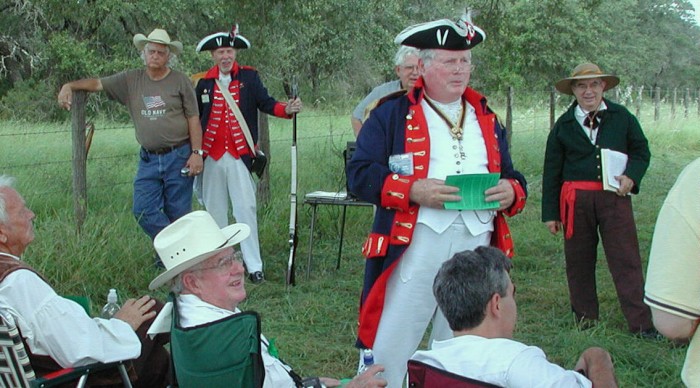
The public is invited to attend the 197th anniversary of the Battle of Medina, at a site in Atascosa County overlooking the Galvan Creek, where we believe between 800 and 1,300 men died August 18, 1813.  This was the bloodiest and largest loss of life of any battle in Texas history, and it occurred about 20 miles south of San Antonio, Texas.  The ceremony will begin at 10:00 a.m. on Saturday, August 21, 2010, and everyone interested in Texas history is invited.  Due to the heat, we will only be at the battle site for about one hour so that each Society can rededicate their marker to American Revolutionary Patriot Peter Sides, and the Sons of The Republic of Texas marker for Benjamin Allen and all the other men who fought and died in this battle.  The SAR, DAR, SRT, DRT, The Daughters of the War of 1812 Society, and the Mayflower Societies will all re-dedicate their markers, making this one of the most honored and dedicated historic sites in Texas.  Members of the Mayflower Society will also re-dedicate their marker for Samuel Alden, a printer from Philadelphia, who is believed to have died after the Battle of Medina and descended from the famous Mayflower Pilgrim.  Our combined Color Guard will present the Colors to begin the ceremony and fire a musket salute to all those who participated in this battle on both sides to conclude the event.  Everyone will then retire to Pleasanton, Texas for lunch on your own, and then reconvene at the Pleasanton Church of Christ located at 1003 North Main Street for an air-conditioned history seminar from 1:00 p.m. to approximately 3:30 p.m. in the church meeting hall.  The Atascosa County Historical Commission members will graciously providing us with refreshments in the afternoon at the church during the symposium again this year. 

The afternoon history seminar will present the latest research on the First Republic of Texas and the Battle of Medina.  Several speakers will be featured, including Robert Thonhoff, KSJ an award winning author, and Dr. Jesus de la Teja, PhD Chair of the History Department at Texas State University, in San Marcos, Texas.  Frank, as Dr. de la Teja likes to be called, is also the former President of the Texas State Historical Association and was appointed the first Texas Historian by Governor Rick Perry.  Norman Porter, Chairman of the Atascosa County Historical Commission, who minored in history, and will present a talk on research conducted in the area showing indications that the Battle of Medina may have occurred in a different location. Richard Santos, author of 34 books, over 3,000 articles and dozens of documentaries and former instructor at Our Lady of the Lake University, Trinity University and School of Aero Space Medicine, Professor at Steve Gonzales, Executive Director of the El Camino Real de los Tejas National Historic Trail and Al McGraw, Archeological Studies Program for TxDOT will also speak on various facets of this historic era.  These are all great speakers and historians, so you don’t want to miss this symposium.

To reach the site for the 10:00 a.m. outdoor ceremony, proceed south from San Antonio on Highway 281 some 15 miles from the intersection of Loop 410 South and Highway 281, to the community of Espey, Texas, and turn right (west) where signs will direct you to the ceremony.  For additional details, contact Tom Green, at (281) 922-1118, or Cell Phone (832) 687-3474.  Wear a hat and comfortable shoes and bring water and a lawn chair that will not easily sink into the sand!

The Battle of Medina was between the Republican Army of the North consisting of approximately a 1,400 men, called the Gutierrez-Magee Expedition by historians, and a Royal Spanish Army commanded by General Joaquin de Arredondo consisting of approximately 1,800 men.  The Republican Army of the North was truly a diverse group, consisting of Tejanos, Native Americans, and adventurers from the U.S.A. with at least one African-American named Thomas.  This was at a time in history when only about 2,000 people lived in San Antonio, called San Fernando de Bexar at the time.  At lease 5 Patriots of the American Revolution were involved in the Gutierrez-Magee Expedition, and at least one of these Patriots fought and died in the Battle of Medina.  Peter Sides, is one of over 50 Patriots of the American Revolution believed to have been buried in Texas.  Direct descendants of Peter Sides are eligible for membership in both the Sons and Daughter of the American Revolution and The Sons and Daughters of The Republic of Texas.  Some of the descendants of Peter Sides will be in attendance for the re-dedication of a Sons of the American Revolutionary Patriot Grave Marker.  A Grave Marker will also be re-dedicated by the Sons of the Republic of Texas, as descendants of all the approximately 3,200 men who fought on both sides of this battle are possibly eligible for membership in the SRT and the DRT.  The descendants of Benjamin Allen, who is also proven to have died in the battle, will re-dedicate the SRT marker.  One of our objectives is to honor the many other participants on both sides of this battle, which is the land battle with the largest loss of life in Texas history.  Toward that end, descendants of the Spanish solders, Native Americans and the native Tejano participants have also been invited to attend this commemorative ceremony.

Prior to the August 18, 1813 Battle of Medina, the Gutierrez-Magee Expedition formed the Republican Army of the North, and won all the preceding battles and declared Texas free from Spain, including a battle at Nacogdoches, a four month siege of the Presidio La Bahia, the Battle of Rosillo Creek, and the Battle of Alazan Creek.  On April 6, 1813, Bernardo Gutierrez de Lara, and his junta, wrote and signed the First Texas Declaration of Independence.  On April 17, 1813, the junta and Governor-Elect Bernardo Gutierrez approved the First Constitution of Texas in present day San Antonio.  A ceremony was held last year in San Antonio commemorating these events.

Earlier in the expedition the Royal Spanish Army surrounded the Republican Army of the North for four months at the La Bahia Presidio near present day Goliad, Texas.  This is believed to have been one of the longest sieges in American military history, and is the reason La Bahia today flies the Emerald Green flag of the Republican Army of the North as one of the nine flags flown over La Bahia.  Come join us and learn about this all but forgotten part of our history.